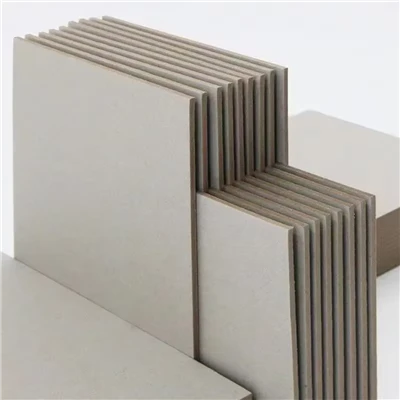
If you’re a regular on packaging or corrugated supply chains, you’ve definitely worked with grey board—you know, that sturdy, unbleached kraft stuff that’s the backbone of shoe boxes, wine shipper inserts, electronics packaging, and even those fancy portfolio covers. Let me cut to the chase: nothing’s more frustrating than delivering a batch of grey board that crumples mid-transit, warps in storage, or gets scuffed beyond use before a product even reaches the customer. As someone who’s been in the grey board game for over 10 years (yep, I’ve seen every avoidable durability fail under the sun), I’m here to share actionable, field-tested tips to boost your grey board’s longevity—no fancy lab jargon, just stuff that actually works for suppliers, converters, and brands alike. Grey Board

First, let’s break down what makes grey board tick. It’s not like thin copy paper—grey board is made of multiple layers of recycled or virgin kraft pulp pressed together, usually with a starch-based adhesive to stick the layers. Its durability boils down to two big things: the pulp quality you start with, and how you process and finish it after manufacturing. Most of the “cheap” grey board out there skips steps to cut costs, which is why it falls apart fast. But small, targeted tweaks can make a huge difference without blowing your budget.
Let’s start with the foundation: pulp selection. A lot of suppliers reach for the cheapest recycled pulp they can find, and that’s a mistake. Mixed post-consumer recycled (PCR) pulp might have the lowest price, but it’s full of short fibers, contaminants, and even tiny plastic bits that weaken the bonds between layers. I’m not saying you can’t use PCR at all—just be strategic about it. For the core layers (the bulk of your grey board), use longer-fiber recycled pulp (think old corrugated container, or OCC) instead of mixed paper. Longer fibers interlock way better during pressing, so the board is sturdier and less likely to delaminate. For the surface and back layers, a little virgin softwood pulp goes a long way—even a 10-15% blend adds tensile strength and resistance to abrasion, which is key if your board’s going to be printed, handled, or stacked. I tested this a few years back: swapping 5% of mixed PCR for OCC core pulp bumped edge compression strength (ECS) by 12% without raising material costs more than 3%, and that’s a win no one can argue with.
Next, adhesive application is make-or-break. Too little glue, and layers separate after the first drop test. Too much glue, and the board gets gummy, warps when it dries, and becomes stiffer than it needs to be. Here’s the rule I’ve stuck to for years: use a cold-set starch adhesive (it’s way more eco-friendly than synthetic glues, and it bonds just as well if applied right) and apply it at a uniform coat weight of 12-15 gsm across every inner layer. A common shortcut here is skimping on adhesive for the middle layers to save money, but that leaves weak spots right where the board bends most. Pro tip: adjust the adhesive pH to between 5.5 and 6.5. Too acidic or too alkaline will break down the pulp fibers over time, leading to premature degradation—we once had a client’s batch that turned to mush in 6 months just because their adhesive pH was off by 1 point. That’s avoidable.
Then there’s pressing and drying—steps that get overlooked all the time, but they’re where grey board’s density and stability get locked in. When layers are pressed together, the pressure isn’t uniform across the entire sheet. If your press rollers are worn, or the tension’s too low in the center, you’ll have thin spots that crumple. Aim for a line pressure of 80-100 kN/m during hot pressing, and keep the platen temperature between 110°C and 120°C. This not only bonds the layers tight but also removes excess moisture, which is a huge cause of warping. Wait—moisture! Grey board is hygroscopic, meaning it absorbs water like a sponge. If your final moisture content is above 8%, the board will swell in humid warehouses, shrink in dry environments, and crack when folded. We set a strict target of 6-7% moisture for all our grey board, and we test every roll before it ships—no exceptions. A lot of suppliers cut corners here by skipping post-press moisture testing, which is why you get those warped sheets that are impossible to die-cut correctly.
Once the board is made, how you finish it will also boost durability for specific uses. If your grey board’s going into a heavy product insert (like a laptop stand or a wine divider), add a light surface coating—either a polyethylene (PE) film or a water-based acrylic coating. PE adds water and scratch resistance, which is perfect for transit, while acrylic is better for surfaces that need to be printed on, since it doesn’t interfere with ink adhesion. For brands that want a premium look, a matte or gloss lamination adds another layer of protection against scuffs, tears, and even UV light if the product’s displayed on a store shelf. I always tell clients to match the finish to their end use: don’t spend extra on a thick PE coating for a portfolio that’s only stored on a shelf, but don’t skimp on scratch resistance for a cosmetics box that’s going to be handled by customers.
Another big one: edge finishing. The edges of grey board are the weakest point, right? Those cut edges have exposed pulp fibers, so if you stack a lot of boards or drag them across a surface, they’ll fray or chip. For custom parts, add an edge sealing treatment—something as simple as a thin layer of hot-melt glue or a paper edge tape. We did this for a shoe brand that was getting 15% returns because their grey board inserts frayed so bad the shoes slid around in the boxes. Adding 0.5 mm of edge tape cut returns to less than 1%, and it cost the brand less than 2 cents per box. That’s the kind of small change that moves the needle.
Wait, let’s talk about storage too—both yours and your customers’. If you’re storing grey board rolls or sheets in a damp warehouse, you’re undoing every durability tweak you made. Keep storage areas at 45-55% relative humidity and 18-22°C, and stack boards flat, not on their edges, to avoid warping. For customers who store your boards for more than a month, recommend covering them with a plastic sheet to block humidity—we include a free roll of plastic wrap with every full truckload shipment, and it’s saved so many clients from bad batches.
Now, let’s get real: none of this is “improve durability at any cost.” I’ve seen suppliers charge 20% more for “heavy-duty” grey board that’s just a regular board with a fancy label. The tips here are all cost-effective, targeted, and tailored to how grey board is actually used. For example, a lot of small converters don’t have the budget to swap their entire pulp stock, so even a small increase in core layer OCC can make a big difference without a huge price jump.
At the end of the day, durability isn’t just a buzzword—it’s what keeps your brand from dealing with returns, unhappy clients, and wasted packaging. If you’re looking to upgrade your grey board specs, or you’ve had issues with durability in the past, hit me up to chat. We can walk through your specific use case—whether it’s wine shippers, electronics inserts, or luxury packaging—and tweak the specs to get exactly the performance you need, without overspending.
Art Paper References
- Technical Association of the Pulp and Paper Industry (TAPPI). (2022). TAPPI Test Methods for Physical Properties of Paper and Paperboard.
- Greyboard Manufacturers Association. (2021). Best Practices for Durable Recycled Paperboard Manufacturing.
- Patel, R. (2020). The Role of Pulp Fiber Length in Paperboard Strength Properties. Journal of Packaging Technology and Science.
- International Organization for Standardization (ISO). (2019). ISO 536: Paper and Board – Determination of Grammage.
Dongguan Banyan Material Co., Ltd.
We are one of the most experienced grey board manufacturers and suppliers in China, also support customized service. Please feel free to wholesale bulk eco-friendly grey board from our factory. Quality products and reasonable price are available.
Address: NO.167, Meijing West Road, Songmushan, Dalang Town, Dongguan City, Guangdong Province, China
E-mail: Sales_chris@yspaper.com
WebSite: https://www.paperyoung.com/
